The RK3576 Development Board is a powerful single-board computer (SBC) designed for developers and engineers to build and prototype applications leveraging the capabilities of the Rockchip RK3576 system-on-chip (SoC). Below is a detailed introduction to the RK3576 Development Board, including its features, specifications, and potential use cases.
The RK3576 Development Board is a versatile platform tailored for AIoT (Artificial Intelligence of Things), edge computing, multimedia processing, and industrial applications. It is built around the Rockchip RK3576 SoC, which integrates a high-performance CPU, GPU, NPU, and advanced multimedia capabilities.

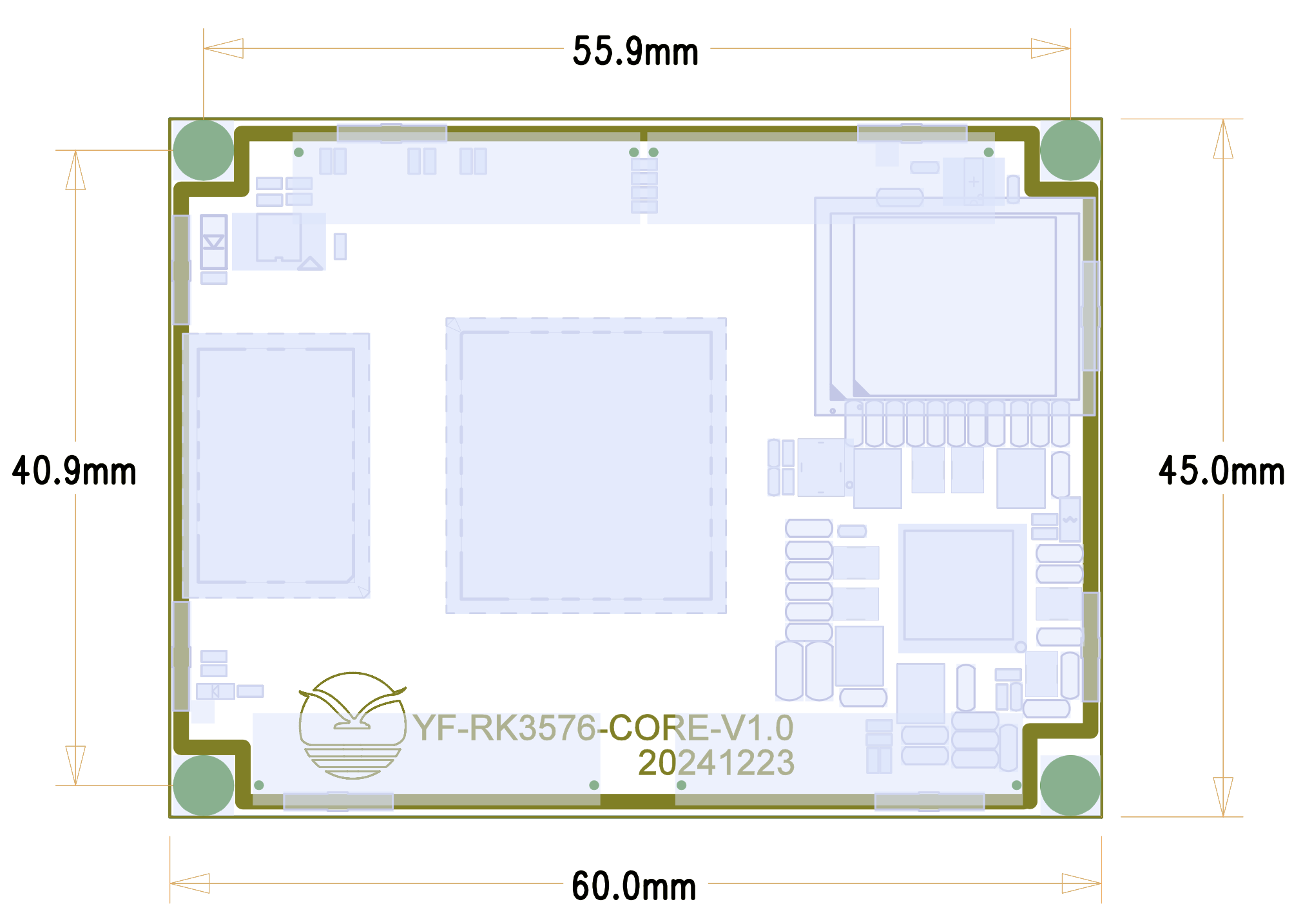
- CPU:
- Quad-core ARM Cortex-A55 + Dual-core ARM Cortex-A76.
- High-performance and energy-efficient processing.
- GPU:
- ARM Mali-G52 GPU.
- Supports OpenGL ES, Vulkan, and OpenCL for graphics and compute tasks.
- NPU:
- Integrated Neural Processing Unit (NPU) for AI acceleration.
- Supports TensorFlow, Caffe, PyTorch, and other AI frameworks.
- Multimedia:
- 4K video encoding and decoding (H.264, H.265).
- Supports multiple display outputs (HDMI, MIPI-DSI).
- Advanced audio processing.
- RAM: 4GB/8GB LPDDR4.
- Storage:
- eMMC (32GB/64GB/128GB).
- MicroSD card slot for expandable storage.
- Wi-Fi: Supports Wi-Fi 6 (802.11ax) for high-speed wireless connectivity.
- Bluetooth: Integrated Bluetooth 5.0.
- Ethernet: Gigabit Ethernet port for wired networking.
- USB: Multiple USB 3.0 and USB 2.0 ports.
- PCIe: PCIe interface for additional peripherals.
- GPIO: General-purpose input/output pins for custom hardware integration.
- I2C/SPI/UART: Standard communication interfaces for sensors and peripherals.
- HDMI: 4K HDMI output for display.
- MIPI-DSI: Interface for connecting MIPI displays.
- Audio: 3.5mm audio jack and digital audio interfaces.
- Input Voltage: 12V DC input.
- Power Efficiency: Optimized for low-power applications.
- Linux (Debian, Ubuntu, Yocto).
- Android.
- Custom RTOS for industrial applications.
The RK3576 Development Board is supported by a comprehensive development ecosystem:
- SDK: Software Development Kit for Linux and Android.
- Toolchain: ARM GCC toolchain for cross-compilation.
- Debugging: JTAG and serial debugging interfaces.
- Documentation: Detailed hardware and software guides.
The RK3576 Development Board is suitable for a wide range of applications, including:
- Smart home devices.
- AI-powered security cameras.
- Voice assistants.
- Real-time data processing.
- AI inference at the edge.
- Industrial automation.
- 4K video streaming and playback.
- Digital signage.
- Gaming and entertainment systems.
- Robotics.
- Machine vision.
- Control systems.
- Learning embedded systems and AI.
- Rapid prototyping of IoT devices.
To start using the RK3576 Development Board:
- Connect the board to a power supply, display, and peripherals.
- Download the SDK and toolchain from the official website.
- Flash the OS (Linux or Android) to the board.
- Use the provided examples and documentation to build and deploy applications.
| Model NO. YF-RK3576-CORE | ||
| Documentation Version: V1.0 | ||
| Product No.: YF-RK3576-CORE | ||
| Product Type | YF-RK3576-CORE Computing | |
| System | CPU | RK3576 with Octa-core , Quad-Core Cortex-A72 and Quad-Core Cortex-A53 |
| DDR(RAM) | LPDDR5 (4GB,8G,16G,32G option) | |
| ROM | Support eMMC5.1 SDIO3.0 (16GB,32GB,64G,128G,256G option) | |
| GPU | Mali-G52 MC3 | |
| NPU | 6.0 TOPS for INT8 Supports INT4,INT8,INT16,FP16,BF16 and TF32 operation | |
| System | Android 14, Debian12, Ubuntu 22.04, Ubuntu 20.04, Linux | |
| Touch screen | 10-Point capacitive touch | |
| Network | WiFi | WiFi6 Wireless, IEEE 802.11a/b/g/n/ac/ax MIMO |
| 5G/4G | supports 5G/4G LTE expansion | |
| Ethernet | 1000M Ethernet x2 | |
| Bluetooth | Bluetooth V5.1 EDR and BLE | |
| Display | HDMI 2.1 OUT x1 | HDMI2.1 (8K@60fps or 4K@120fps) |
| DP1.4 OUT x1 | DP1.4 (8K@30fps) , multiplexed with USB3.0 | |
| HDMI IN | HDMI-IN (4K@60fps) , Supports HDCP 2.3 | |
| MIPI-CSI IN x1 | 2lane MIPI-CSI input x1 | |
| Audio | Speaker x1 | Speaker OUT |
| HDMI Audio OUT x1 | HDMI Audio OUTPUT | |
| DP Audio x1 | DP Audio OUTPUT | |
| HDMI Audio IN x1 | HDMI Audio INPUT | |
| PCIE | PCIe3.0 x1 | PCIe3.0 (4Lane), can expand with standard PCIe3.0 devices |
| M.2 | M.2 x1 | M.2 interface (SATA3.0) |
| SATA3.0 x3 | Standard SATA3.0 interface | |
| USB Host | USB Host 2.0 Type-A x2 | USB Host 2.0 2.0mm-4pin x2 (Limit 500mA) |
| USB Host 3.0 | USB Host 3.0 x1 (Limit 1A) | |
| USC-C | USB-C (USB3.0 / DP1.4) (Limit 2A) | |
| Others | Power Jack | DC power input |
| RJ45 | Ethernet with POE | |
| Industrial | RS485 x1; RS232 x1; GPIO x8; I2C x1; Heating 12V x1; GPIO x6 | |
| Multimedia | Video format | MPEG-1,MPEG-2,MPEG-4,H.263,H.264,VC1,RV etc.,support up to 4K Video decode – H.264/H.265/VP9 Video encode – 1080p60 H.264/H.265 |
| Audio format | MP3/WMA/AAC etc. | |
| Photo | jpeg/jpg/png etc. | |
| Others functions | Wireless mouse | Support |
| Wireless keyboard | Support | |
| Language | Multi-language | |
| Working temp | 0--40degree | |
| Certificates | CE,ERP,ROHS,REACH,SCCP,PAHS | |
| Accessories | Adapter | Adapter,12V,2A |
| Desktop Bracket | Standard | |
| User manual | YES | |
- Website: www.we-signage.com
- https://we-signage.en.made-in-china.com/
- E-mail: dennis@we-signage.com
- MP/Wechat: +86 13349909990
- Whatsapp: +86 17757838687
- Skype: solled686