Benchmark and self-optimize SDK, CLI, and MCP guidance so every agent model can use your tool reliably.
skill-optimizer runs your SDK / CLI / MCP docs against multiple LLMs, measures whether they call the right actions with the right arguments, and iteratively rewrites your SKILL.md / docs until a floor score is met across every model.
Built by the team at Fast — payment infrastructure for AI agents. Give your agent a wallet in 3 lines of code.
Requirements: Node.js 20+, plus either an OpenRouter API key or a local Codex login when using direct OpenAI models.
skill-optimizer run benchmarks your callable surface against multiple LLMs — it discovers actions, generates tasks, calls each model, and statically evaluates action recall and argument accuracy to produce a PASS/FAIL verdict (exit 0/1) usable in CI.
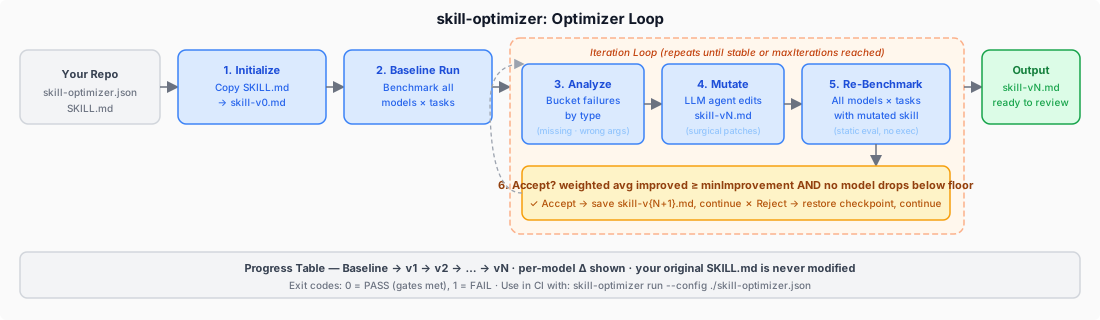
skill-optimizer optimize runs the benchmark as a feedback loop: it copies your SKILL.md, mutates it with an LLM agent, re-benchmarks, accepts only when scores improve, and repeats until stable. Your original SKILL.md is never modified.
git clone https://github.com/fastxyz/skill-optimizer
cd skill-optimizer
npm install
npm run build
npm link # makes `skill-optimizer` available globallyexport OPENROUTER_API_KEY=sk-or-...For direct OpenAI API calls you can use your local Codex browser login instead of exporting OPENAI_API_KEY — set format: "openai" and authMode: "codex":
{
  "benchmark": {
    "format": "openai",
    "authMode": "codex",
    "models": [
      { "id": "openai/gpt-5.4", "name": "GPT-5.4", "tier": "flagship" }
    ]
  }
}
Codex auth reads a browser-login JWT or a static OPENAI_API_KEY from ~/.codex/auth.json. It only applies to openai/ model refs; openrouter/ models always use OPENROUTER_API_KEY.
Step 1 — Scaffold config (run from your project root):
npx skill-optimizer init cli # or: init sdk, init mcp, init promptThe wizard asks for your repo path, models to benchmark, and where your SKILL.md lives. It creates a .skill-optimizer/ directory:
.skill-optimizer/skill-optimizer.json— the main config (commit this).skill-optimizer/cli-commands.json— CLI surface manifest (template to edit, or auto-extracted).skill-optimizer/tools.json— MCP surface manifest (template to edit)
Step 2 — (CLI/MCP only) Extract your surface if code-first discovery yields nothing:
npx skill-optimizer import-commands --from ./src/cli.ts
# or for a compiled binary:
npx skill-optimizer import-commands --from my-cli --scrape
Step 3 — Run a benchmark:
npx skill-optimizer run --config ./.skill-optimizer/skill-optimizer.jsonStep 4 — Run the optimizer (iteratively improves your SKILL.md):
npx skill-optimizer optimize --config ./.skill-optimizer/skill-optimizer.jsonThe optimizer never modifies your original SKILL.md — it works from versioned local copies in .skill-optimizer/ and prints a progress table at the end showing per-model improvement.
Non-interactive / CI mode:
# Accept all wizard defaults without prompts
npx skill-optimizer init cli --yes

# Load answers from a JSON file
npx skill-optimizer init --answers answers.json
answers.json format:
{
  "surface": "cli",
  "repoPath": "/absolute/path/to/your-repo",
  "models": [
    "openrouter/anthropic/claude-sonnet-4.6",
    "openrouter/deepseek/deepseek-v3.2",
    "openrouter/google/gemini-2.5-flash",
    "openrouter/qwen/qwen3.5-397b-a17b",
    "openrouter/moonshotai/kimi-k2.5",
    "openrouter/z-ai/glm-5.1",
    "openrouter/minimax/minimax-m2.7",
    "openrouter/google/gemma-4-31b-it",
    "openrouter/meta-llama/llama-4-maverick"
  ],
  "maxTasks": 20,
  "maxIterations": 5,
  "entryFile": "src/cli.ts"
}
Key config fields in .skill-optimizer/skill-optimizer.json:
| Field | What it does | Set it to |
|---|---|---|
target.repoPath |
Root of the project being benchmarked | Absolute or relative path to your repo |
target.discovery.sources |
Source files to scan for callable methods/commands/tools | e.g. ["../src/index.ts"] or ["../src/server.ts"] |
target.skill |
Docs file the optimizer will edit | Path to your SKILL.md or equivalent guidance doc |
benchmark.models |
Models to benchmark | Model IDs with provider prefix: openrouter/<provider>/<model> (via OpenRouter), anthropic/<model> (direct Anthropic), openai/<model> (direct OpenAI) |
benchmark.authMode |
How model auth is resolved | env (default), codex, or auto |
Benchmark how well models follow your prompt templates:
skill-optimizer init prompt
skill-optimizer run
The prompt surface discovers phases and capabilities from your SKILL.md,
generates scenario-based tasks, and evaluates output quality — not just
tool calls. Each task is tagged with the specific capability it exercises
(capabilityId), and scoring is performed against that capability's
criteria — not the first discovered capability. It scores responses on
required sections, format patterns, forbidden keywords, and structural
elements (code blocks, numbered lists, tables). Coverage violations do
not hard-fail prompt runs; coverage is informational for the prompt
surface. This lets you optimize prompt templates the same way you
optimize SDK/CLI/MCP guidance.
- Discover callable surface (SDK methods / CLI commands / MCP tools / prompt phases) via tree-sitter, manifest, or markdown parsing.
- Scope the surface with
target.scope.include/target.scope.excludeglobs. - Generate tasks — one prompt per in-scope action, coverage-guaranteed.
- Benchmark — every configured model attempts every task; static evaluator checks action calls + args.
- Verdict — PASS/FAIL against two gates (per-model floor, weighted average).
- Optimize — create a local versioned copy of your
SKILL.md(skill-v{N}.mdin.skill-optimizer/), mutate it, re-benchmark, accept only if both gates hold, rollback if not. The target repo's original skill file is never modified. - Recommendations — on FAIL, one critic call summarizes what to improve manually.
- Progress table — after the optimizer finishes, a per-model table shows Baseline → each iteration → Final → Δ so you can see exactly where each model improved.
See docs/reference/config-schema.md for the full generated config reference — auto-updated at every build.
See docs/reference/errors.md for all error codes, descriptions, and fix instructions.
Every benchmark run produces one of two verdicts: PASS or FAIL.
Two gates must both be satisfied for a PASS:
benchmark.verdict.perModelFloor(default0.6): every model must pass at least this fraction of tasks. A single model below the floor fails the run, regardless of the average.benchmark.verdict.targetWeightedAverage(default0.7): the weighted average score across all models must reach this threshold.
benchmark.models[].weight (default 1.0): heavier-weighted models count more toward the weighted average. Use higher weights for flagship models you care most about.
The optimizer only accepts a mutation when:
- the weighted average improves by at least
minImprovement, AND - no model that was above the floor drops below it.
Exit codes: 0 = PASS, 1 = FAIL — usable directly in CI pipelines.
Control which actions are benchmarked with target.scope:
target.scope.include(default["*"]): glob patterns for actions to include.target.scope.exclude(default[]): glob patterns for actions to exclude.
The * wildcard matches any sequence of characters including dots and slashes — it is not limited to a single path segment.
Examples:
"Wallet.*"— includes all Wallet methods"*.internal*"— excludes anything with "internal" anywhere in the name"get_*"— includes only getter actions
Task generation is coverage-guaranteed: every in-scope action gets at least one task. If the first generation pass misses any, a targeted retry runs (max 2 iterations). If coverage still fails, an error names the uncovered actions and suggests either fixing SKILL.md guidance or adding them to scope.exclude.
Rough LLM spend per run:
- Baseline benchmark: N models × M tasks LLM calls.
- Optimizer iteration: 1 mutation call + N models × M tasks re-benchmark per iteration.
- Recommendations: 1 critic call, only on FAIL verdict.
No per-failure LLM calls — feedback is deterministic (structured failure details + patterns + passing/failing diffs).
The optimizer's coding agent is powered by @mariozechner/pi-coding-agent. OpenRouter-backed runs still use your configured API key env var. Direct OpenAI runs can use either OPENAI_API_KEY or the browser-login tokens that Codex stores in ~/.codex/auth.json.
Missing OPENROUTER_API_KEY: Set it in your shell before running:
export OPENROUTER_API_KEY=sk-or-...Using Codex auth: Set benchmark.authMode (and optionally optimize.authMode) to "codex" or "auto" and use direct OpenAI model refs such as openai/gpt-5.4. Codex auth only applies to the openai provider and reads either a browser-login access token or OPENAI_API_KEY from ~/.codex/auth.json. Alternatively, set benchmark.format to "openai" with authMode: "codex" and openai/... model IDs — the client bridges to the Pi/Codex path automatically.
Dirty git: The optimizer requires a clean git state in the target repo (requireCleanGit: true by default). Commit or stash uncommitted changes before running. Note: the optimizer never writes to the target repo's skill file — it works from local versioned copies in .skill-optimizer/.
maxTasks < scope_size: benchmark.taskGeneration.maxTasks must be >= the number of in-scope actions. Run npx skill-optimizer --dry-run --config .skill-optimizer/skill-optimizer.json to see the count without making LLM calls.
Empty scope: target.scope.include matched nothing. Check your glob patterns — remember * matches everything including dots.
See CONTRIBUTING.md.